Janaki, daughter of the Earth: a modern perspective
It is Sita, not Rama, whose character is central to the Ramayana. An essay that reads Janaki's life through modern eyes: bound by convention yet free, devoted yet fiercely self-respecting and aware of her rights.
In Indian literature, the character of Janaki, daughter of King Janaka, is unique and wondrous. She is bound by countless social conventions, and yet she is free. She has her own mind and refined thoughts. Valmiki himself seems to have been born of Sita's character; he even says that the central character of the Ramayana is not Rama but Shri Sita. Take Sita out of the Ramayana and Rama loses his distinction. She is truly great: from head to toe a complete Indian woman, whose life's journey leads from her father's home to her husband's home, yet whose own identity remains vivid throughout.
The scriptures say, "Putri pavitra kiye kul dou": a daughter sanctifies both families. A very capable son uplifts only one family, his father's. But a very capable woman who faithfully follows her own dharma can uplift both her husband's and her father's families. Sita explained to the world what a woman's dharma is. In truth, women are generally more patient, more thoughtful and more generous than men. A woman leaves her birthplace and her parents, embraces another family as her own and devotes herself wholeheartedly to nurturing it (exceptions aside).
Introducing Vaidehi, her mother-in-law Kaushalya says: "Her father Janaka is the jewel among kings, her father-in-law the sun of the Solar dynasty, and her husband the moon that makes the lotus-grove of the Solar race bloom, a treasury of virtue and beauty" (Ayodhya Kand, doha 58, page 331). The good fortune of so extraordinary a woman as Sita is boundless.
Vaidehi in the flower garden
In the Ramcharitmanas we meet Vaidehi's distinctive qualities from the Bal Kand itself.
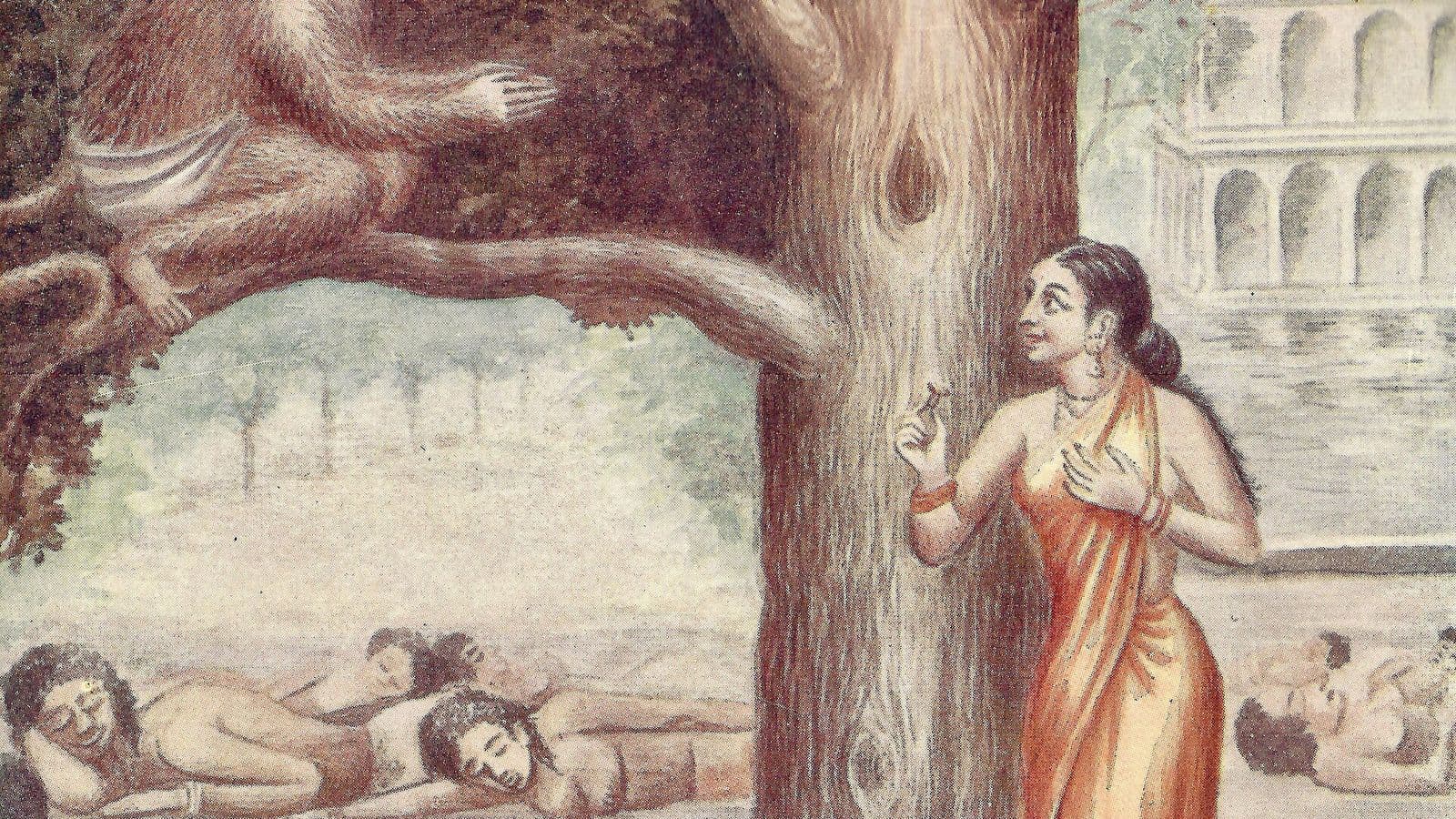
As she picks flowers for worship with her friends in the garden, her girlish, carefree nature shines through. When her friends tell her that two exceedingly handsome princes of King Dasharatha of Ayodhya, Rama and Lakshmana, have also come into the garden, her heart longs to see them. Like a startled doe she glances here and there, and just then the two brothers appear from among the creepers. Rama's gaze too comes to rest on her, still and absorbed. At the sight of him Vaidehi forgets herself. For a moment, shy, she closes her lovely lotus eyes, then opens them again: before her, an endless ocean of beauty from head to foot, dark and graceful Shri Rama stands gazing at her.
Thinking she has been caught stealing a glance, she is unsettled for an instant. How can a proud young woman admit that she is almost swooning before his extraordinary presence? Quickly she fixes her eyes on the blooming roses beside which Raghunath stands. Then, as if indifferent to anyone's presence, she composes herself with great poise, adjusts the end of her sari and, on the pretext of looking at the deer, the birds and the trees, turns again and again to hold Rama's image in her eyes, thrilled. Her heart overflows. She begins to feel the heavenly touch of love's priceless emotions. Is this sweet music of wondrous love echoing in his heart too? Is he thinking the same about me?
Suddenly she remembers her father's hard vow, and beads of sweat gather on her moon-like face even in the mild weather. Agitated, she hurries away to the place where she spends a part of every morning: the shrine of her beloved goddess, Mother Bhavani.
In the temple of Mother Parvati on the right side of the garden she kneels and prays, "Jai jai girivar raj kishori" (Victory to the daughter of the king of mountains). She feels shy before the goddess at her own impatience in love, yet she also feels boundless faith in this newborn affection and is reassured: whoever truly loves someone will surely win them, without a doubt. Mother Parvati too is moved: "Hear, Sita, my blessing is true," she says, and the garland on the idol slips as the image smiles. The mother blesses her: "Your heart's wish will be fulfilled." Sita's devotion to God is boundless.
The broken bow and the wedding
Meanwhile the mighty kings who failed to break the bow grow more and more bitter. Looking at Shri Rama with envy and malice, they begin to talk loudly of carrying Vaidehi off by force or winning her in battle. Rama goes to his guru, and Sita, returning to her mother, wonders about the immorality of these wicked kings and what fate has in store. From the window, brows arched in anger, she watches the kings; she cannot bear to hear a single unkind word about Rama now. Silently remembering Bhavani, she prays again and again that Shri Rama be declared the victor. Her prayer is heard: before all the great warriors gathered there, the youth, tender as a new leaf, wins the glory of breaking the bow. A sweet roar of joy rises all around. Who here today is happier or more fortunate than Janaki?
How soft-spoken, loving and dutiful Janaki is, King Dasharatha learns from King Janaka's servant who brings the wedding letter to his court in Ayodhya. Overjoyed to hear that his sons are well and are to be married, the king takes off his pearl necklace to reward the servant, but the man humbly declines: he cannot even drink water at a daughter's in-laws' home. The king is puzzled. Seeing his confusion, the servant explains, "It is true she is King Janaka's daughter, but Sita honours even us servants as she would her father, so is she not our daughter too?" King Dasharatha's eyes fill with tears: so thoughtful and virtuous a girl as Sita is coming to be his daughter-in-law.
She is shy by nature too. At the garland ceremony she is so overwhelmed with emotion and modesty that she simply cannot place the garland round Shri Rama's neck.
Even after the wedding, though her friends urge her again and again, she cannot bring herself to touch Shri Rama's feet, remembering Ahalya, wife of the sage Gautama.
Obedient in her father's house and everyone's darling, beloved Vaidehi does not forget her good conduct, discernment, values and dignity on coming to her husband's home in Ayodhya. She honours her in-laws sincerely and treats her young brothers-in-law, their wives, relatives, and the palace servants, attendants and subjects with warmth. Exceedingly soft-spoken, delicate and full of sweetness, Vaidehi is Vaidehi alone.
The resolve to go to the forest
Deeply distressed at the news of Shri Rama's exile, Vaidehi comes to her mother-in-law Kaushalya, bows at her feet and stands silently with her head lowered. Rama is there. Her mother-in-law showers blessings on her, but Vaidehi's mind is elsewhere, fixed on a corner of the horizon. Her lord is going to the forest; who will go with him, body and soul together, or only the soul? Who has ever understood the workings of fate? Mother Kaushalya reads her anguish well and says to Shri Rama: "Listen, my son. Vaidehi is very delicate and the darling of her in-laws and the whole family. She is the daughter of the great Janaka, Dasharatha's daughter-in-law and your other half, Rama, a most fortunate woman. I have found a daughter-in-law who is beauty, virtue and good fortune itself. Vaidehi has never left lap, bed and swing to set foot on rough ground. Even in the gardens of Janakpur, carpets of soft grass were laid for her. I have always guarded her carefully, like the life-giving sanjeevani herb, and never asked her even to trim a lamp's wick. That same delicate girl wants to go to the forest with you. My heart is troubled. What is your wish?" Janaki knows how torn Shri Rama is in this terrible situation.
Only Kol and Bhil women, female ascetics and demonesses can live in the complex, harsh and frightening world of the forest. Glancing at Vaidehi from the corner of his eye, his heart melted.
He tried his utmost to persuade Janaki to stay in the palace, where she could also serve the mothers and do good for the whole family. In private he painted a frightening picture of the outside world and its hardships: the sun, cold and rain of the forest are all terrible; mountain caves, rivers, streams and gorges are so impassable and deep that one dare not even look at them; bears, tigers, wolves, lions and elephants roar so fearsomely that even the bravest lose their nerve; one must sleep on the ground, walk on gravel, stones and thorns, wear clothes of bark and leaves and live on roots and tubers, and on top of that, man-eating beasts and demons in many deceptive forms lie in wait.
It was an hour of trial, but there is not the slightest unease in Janaki's heart. She has no fear; no one can shake her from her goal. After a while, asking her mother-in-law's forgiveness for her boldness, she says, "Forgive my great discourtesy, mother," but I have understood that "there is no sorrow in the world like separation from one's husband." Then, turning to her husband, she says: "O lord of my life, without you even heaven would be hell to me. Body, wealth, home, land, city and kingdom are all sorrow to a woman without her husband. My lord, when I was a child an ascetic Brahmin told me that I would live in the forest with my husband. So that the word of that devout Brahmin does not prove false, I must go to the forest with you. There the animals and birds will be my family, roots and tubers will taste like nectar, and the forests, mountains and caves will be like the hundreds of palaces of Ayodhya. So, O friend of the helpless, if you keep me in Ayodhya apart from you for fourteen years, my life will surely not survive."
Shri Rama had no choice but to honour the wishes of that proud woman.
Unshaken in the Ashoka grove
For all those years in the forest she was happy in her own way, living as her husband's shadow. But fate was sitting somewhere, preparing to write something else. Even when Ravana abducted her by deceit, her sharp intelligence did not desert her. She sensed that Shri Rama would surely search for her, and that there must be some sign of the way. So she began dropping her few ornaments at intervals, and these later became the means of reaching Lanka.
How far apart they were: the terrible ten-headed Ravana and the delicate, fair-faced Sita.
Vaidehi sits under heavy guard in the strange Ashoka grove. Ravana comes again and again with his attendants in many guises to frighten her, threaten her, tempt her and bend her to his will. Ravana was supremely rich; his whole Lanka was built of gold, while Rama had in Ayodhya just one golden house, the Kanak Bhavan. Yet she sits fearless and does not even raise her eyes to look at him. In her eyes there is no one on earth greater than Shri Rama. The harder Ravana tried to conquer Vaidehi's inner world, the more crushing his failure. Before her he felt he did not exist, and burned all the more with rage. Despite persuasion, bribes, fear and anger, Vaidehi never once looked up at him. When she absolutely had to speak, she held a blade of grass between them, as Tulsidas writes, and, remembering her beloved lord of Awadh, let a few words fall with her eyes lowered.
Even by tempting her with Mandodari and all his other queens as her servants and offering to make her his chief queen, he could not shake her faith from Shri Rama's feet. Such was the radiant character of Mithila's daughter.
When Hanuman was entrusted with finding Sita, Shri Rama described her to him, saying that wherever she was, the very roof, the very walls, even her own body, would be echoing with the name of Rama. He too had unshakeable faith in the love of Sita, the queen of his heart.
Deeply pleased with Hanuman's extraordinary feat in Lanka, Sita blessed him as "the giver of the eight siddhis and nine treasures". She was full of gratitude, and always expressed what was in her heart through kindness, gifts and blessings.
The fire ordeal and self-respect
According to the Valmiki Ramayana, after the victory in Lanka, on seeing Janaki Shri Rama said (and he said it only for the world's sake): "O noble lady, the effort I have made in this battle was not for you. I fought this war to save myself from reproach and to wipe away the stain on my illustrious lineage. What man would accept a woman who has lived in another's house? Who would accept a woman like you, taken onto Ravana's lap and looked upon with his wicked, lustful eyes? So, noble lady, after much thought I have decided that you may live happily with Lakshmana or Bharata, or with Sugriva, king of the monkeys, or with Vibhishana, king of the rakshasas, or wherever your own judgement and heart desire."
In reply Vaidehi says: "Lord, there was no desire in the touch my body suffered. I was helpless; so the fault is not mine but my fate's. When you sent the brave Hanuman to me in Lanka, why did you not tell me then that you would behave like this? I would have given up my life the moment I heard it from the monkey chief. A man as noble as you should not, overcome by anger, behave like a small-minded person. This reward you have given my womanhood is unworthy of you. Knowing the story of my birth, you have still behaved this way, without remembering that we are married and that I am wholly devoted to you. You have forgotten my devotion and my virtue, everything." (Alochana quarterly, page 66, millennium issue 33). Even after this, not a trace of bitterness towards her beloved arose in her heart.
As a woman abandoned by her husband when about to give birth, living only to educate her children, her character is equally worthy of emulation. She contributed greatly to her children's moral development and taught them in keeping with the great traditions of the Raghu dynasty. Never, anywhere, driven by pride, mental pain, terrible humiliation or personal interest, did she poison their tender, gentle, sweet minds.
There was another side to this brave, determined, dutiful and wise woman, one that made her firm and alert to her own interests. When Ravana, who was also an accomplished physician, gave her a laddoo-like medicine made of herbs to eat during an illness, Janaki flung it away with complete detachment as something worthless; it grew into a tree, and in Lanka it still grows as fruit on those trees. Likewise, in the Ashoka grove Janaki had drawn a line around herself beyond which she never stepped.
It is said that Sita shed so many tears weeping in separation from Shri Rama that they are still known in Sri Lanka as Sita Kund. From this one can imagine that, separated from her husband, Vaidehi's wagtail-like eyes were not free of tears for even an instant.
A wondrous lover, who knew only how to lose herself in love.
Another remarkable trait of Sita's character is that in Lanka, of which Tulsidas wrote, "Lanka is home to hordes of demons; how could a good soul live here?", she found herself a friend even among those fearsome beings. With Trijata, who happened to be a devotee of Shri Rama, she shared her sorrow and asked her for fire so she could end her life. Like a true friend, Trijata comforted and reassured her and kept her from doing so. Sita never grew angry. Even Shri Rama's eyes would redden as he slew the demons, but Janaki was as cool as the moon, an ocean of kindness and compassion. When Raghunandan was destroying the demons in Lanka, on Sita's command not a single demoness was killed.
At one point Sita tells Hanuman that those who repay with love are the true saints. Enmity is quelled not by enmity but by love. The one who repays harm with kindness and insult with respect is a saint. What a wonderful, extraordinary thought.
Devotion with self-respect
A special quality of Vaidehi's character is that, while being a supremely devoted daughter, beloved, daughter-in-law, wife and mother, she is also an aware woman who fights for her rights and is ready to answer her humiliation with perfect calm. She did not even count thirteen years of exile as hardship, for she had her beloved beside her, and she bore a year of Ravana's terror for Raghunath's sake alone; but the sting of being abandoned by Shri Rama she could not bear.
When Shri Rama comes to take her back to Ayodhya, the daughter of the Earth, invoking her radiance, chastity and devotion, prays to Mother Earth to open up so that she may sink into it with all her sorrows. The story goes that, hearing her heart-rending plea, a wide fissure opened in the earth and she passed into it.
Then Shri Rama's heart-breaking grief at the separation was plain to see. Having lost his other half, he was restless; but before destiny even he was helpless.
In truth, Janaki's whole life is that of a supremely wise Indian woman who stays devoted to her husband and family in body, mind and wealth, yet never forgets her self-respect, her identity and her duty. She is a complete woman. Her life story is a rare confluence of the most modern and the traditional.